Why Is HCL Buying a Tiny Croatian AI Company? The Robotiq.ai Deal, Explained
HCLSoftware is paying €9 million for Robotiq.ai, an 8-year-old Croatian firm with about €1.4M in revenue. Here's why a giant is buying something this small.
Dev Shah
16 October 2026
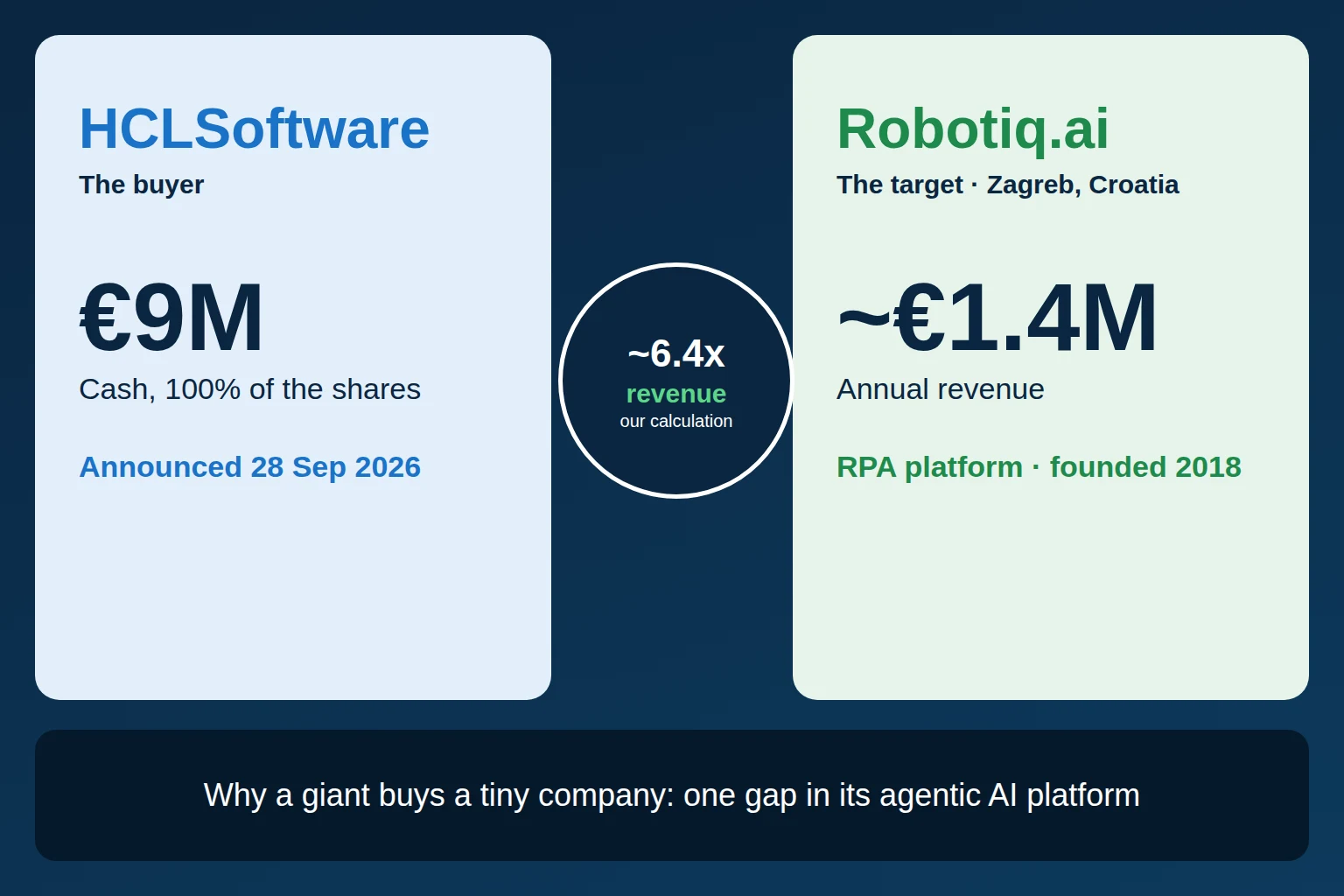
Quick answer: HCLSoftware is paying about €9 million in cash for Robotiq.ai, a Zagreb RPA company with roughly €1.4 million in revenue, because it fills one gap in HCL's agentic AI platform: carrying out tasks inside applications that lack clean APIs. It is a bolt-on technology purchase at about 6.4 times revenue (our own calculation), not a bet on scale.
Status: Announced, not yet closed. On September 28, 2026, HCLSoftware, the software products division of HCL Technologies, announced its intent to acquire Robotiq.ai, a small automation software company based in Zagreb, Croatia. The deal is worth just €9 million in cash and is expected to close in November 2026. If you've never heard of Robotiq.ai, that's the point of this piece: understanding why a company the size of HCL bothers with a target this small tells you something useful about how acquisitions actually work at the technical, bolt-on end of the market, not just the billion-dollar end. For a contrast at that end, see Coforge's $2.35B Encora acquisition, explained.
What's Actually Being Bought
The buyer isn't HCL Technologies directly. It's HCL Technologies Austria GmbH, a wholly owned subsidiary set up under HCLTech specifically to hold acquisitions like this one, and it will buy 100% of Robotiq.ai's shares. The €9 million enterprise value is subject to the usual adjustments for the target's net debt and working capital at closing, so the final cheque could move slightly from that number.
| Item | Detail |
|---|---|
| Buyer | HCL Technologies Austria GmbH, a subsidiary of HCLTech, acquiring on behalf of HCLSoftware |
| Target | Robotiq.ai (Robotic Process Automation d.o.o.), Zagreb, Croatia |
| Stake | 100% of outstanding equity |
| Price | €9 million, cash, subject to adjustments |
| Announced | September 28, 2026 |
| Expected close | November 2026 |
| Sector | Enterprise software, robotic process automation (RPA) |
What Robotiq.ai Actually Does
Robotiq.ai builds what's called an RPA platform, software that automates repetitive, manual tasks inside a business's existing applications, the kind of work a human would otherwise do by copying data between systems or filling in the same form over and over. Founded in 2018, it's an eight-year-old company with a small team, and its customers include banks, insurance companies, and telecom providers, the kind of large, process-heavy organisations that have the most repetitive work to automate. Its platform carries ISO-certified security and audit logging, which matters a lot to the kind of regulated customers it sells to.
HCLSoftware's own reported reason for buying it is specific: its existing AI platform, called HCL UnO Agentic, is good at deciding what should happen and orchestrating a process, but it needs a way to actually execute tasks inside applications that don't offer a clean API to plug into. That's exactly what RPA software does. In HCLSoftware President Kalyan Kumar's words, the deal "strengthens HCL UnO Agentic by combining orchestration with enterprise-grade execution, helping customers confidently deploy and scale agentic AI across their operations."
The Number Worth Sitting With
Robotiq.ai reportedly had around €1.4 million in revenue in its most recent financial year. Divide the €9 million purchase price by that, and HCL is paying roughly 6.4 times Robotiq.ai's revenue for the whole company. That's our own calculation from the two disclosed figures, not something either company has stated directly, and it's worth being upfront that we couldn't independently confirm Robotiq.ai's profit figures, so we're not asserting a profit-based multiple here, only the revenue-based one.
What that multiple tells you is that HCL isn't buying Robotiq.ai for its current size. A company doing €1.4 million a year is genuinely tiny next to HCLSoftware, which serves more than 20,000 organisations worldwide, including a majority of the Fortune 100. HCL isn't buying customers, scale, or even much revenue. It's buying a specific, working piece of technology that would otherwise take time to build internally, and a small team that already knows how to make it work for large, regulated customers.
Why Buy Small at All
This is the more useful lesson buried in a deal this size: not every acquisition is about growth by addition. Sometimes a company identifies one specific gap in what it can offer, RPA execution, in this case, and the fastest way to close that gap isn't to build it from scratch or to find a bigger company doing the same thing badly. It's to find a small, focused team that has already solved that one problem well, and buy them outright.
This is also why the price looks small against HCL's size but not necessarily against what Robotiq.ai actually is. A company that's spent eight years perfecting one specific capability, with real enterprise customers already trusting it with sensitive processes, is worth more per employee than its revenue alone suggests. Revenue tells you how big a business is today. It doesn't tell you how hard the thing it built would be for someone else to replicate.
If You're Buying a Much Smaller Business
Two things from this deal apply directly even if you're nowhere near HCL's scale.
First, don't judge every acquisition target purely on its financials. If you're looking at a small, specialised business, a workshop with one unusual certification, a service provider with one hard-to-replace client relationship, a supplier with a specific process nobody else in the area has figured out, the right question isn't only "what's their revenue." It's "how long would it actually take me to build or find this myself, and what's that worth." A target that looks expensive on a revenue multiple can still be cheap against the cost and time of doing without it. Our guide on how to value a small business in India covers the methods in more detail.
Second, notice that HCL didn't buy Robotiq.ai directly. It bought it through a subsidiary set up for exactly this purpose. You don't need HCL's scale to use the same idea: buying through a separate holding entity, rather than directly in your own name or your existing company's name, can keep the new acquisition's liabilities and risks separate from what you already own. It's worth asking your lawyer early whether a deal you're structuring should sit inside a new entity rather than your existing one, for exactly this reason. Agree the price and structure in writing early too, which is what a letter of intent is for.
Frequently Asked Questions
Has HCL actually completed the purchase of Robotiq.ai?
Not yet. As of the announcement on September 28, 2026, this is a signed intent to acquire, with completion expected in November 2026, subject to customary closing conditions.
How much is HCL paying for Robotiq.ai?
Around €9 million in cash, for 100% of the company's shares, subject to standard adjustments for net debt and working capital at closing.
What does Robotiq.ai actually make?
An RPA, or robotic process automation, platform that automates repetitive manual tasks inside a business's existing software, particularly useful where a proper integration or API isn't available. Its customers include banks, insurance firms, and telecom companies.
Why would a large company like HCL want such a small business?
To fill one specific gap in its own product. HCL's AI platform can decide what should happen in a process, but needed a proven way to actually carry out tasks inside other applications. Buying Robotiq.ai was faster than building that capability from scratch.
Which part of HCL is actually making the purchase?
HCL Technologies Austria GmbH, a subsidiary of HCLTech, is the buying entity, acting on behalf of HCLSoftware, HCLTech's software products division.
Stay Updated
Get the latest insights on business acquisition delivered to your inbox.
Subscribe to Newsletter