Coforge's $2.35B Encora Acquisition, Explained: How an Indian IT Firm Bought Its Way to AI Scale
Yes — Coforge is paying $2.35B (~₹20,445 crore) entirely in its own stock for Encora, the largest ER&D acquisition ever by an Indian IT firm. Deal structure, valuation multiple, and what it signals for the sector.
Dev Shah
4 August 2026
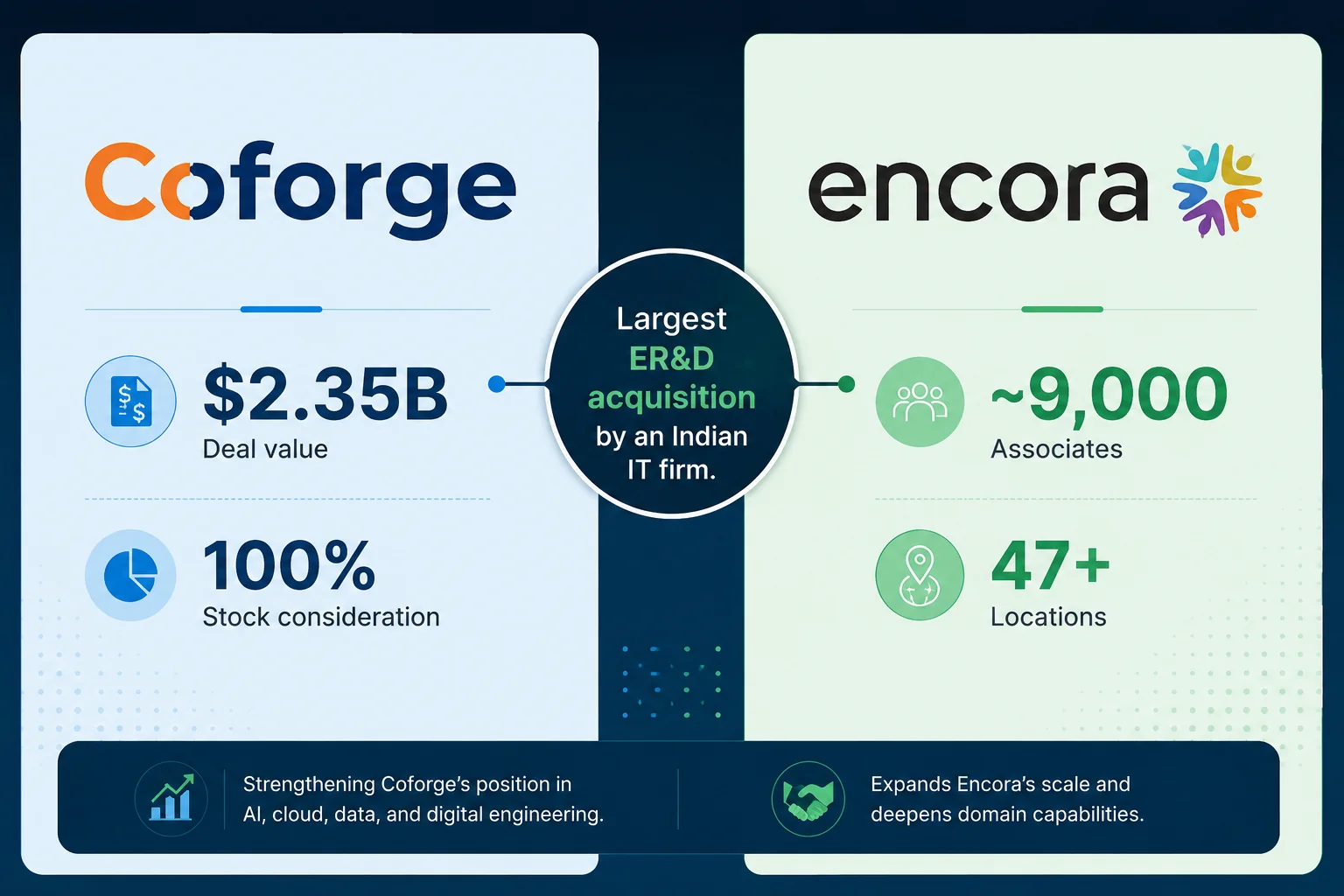
Coforge is paying $2.35 billion — entirely in its own stock — for Encora, a Santa Clara-based digital engineering firm, in the largest engineering R&D (ER&D) acquisition ever made by an Indian IT company. That headline is true and also not the interesting part. The interesting part is the mechanism: two private equity sponsors, Advent International and Warburg Pincus, converted a controlling private position into a liquid ~20% minority stake in a publicly listed acquirer — priced by a strategic buyer that needed AI-services scale faster than it could build it.
The Snapshot
| Buyer | Coforge Ltd (NSE: COFORGE), Noida-headquartered, publicly listed Indian IT services company |
| Target | Encora Digital LLC, Santa Clara-headquartered digital engineering / AI product-development firm, founded 2000 |
| Sellers | Advent International (majority sponsor since Dec 2021) and Warburg Pincus (minority since 2019), plus other minority holders and management |
| Sector | IT services / Engineering R&D (ER&D) / AI-led product engineering |
| Size / price | $2.35B (~₹20,445 crore) enterprise value, 100% all-stock |
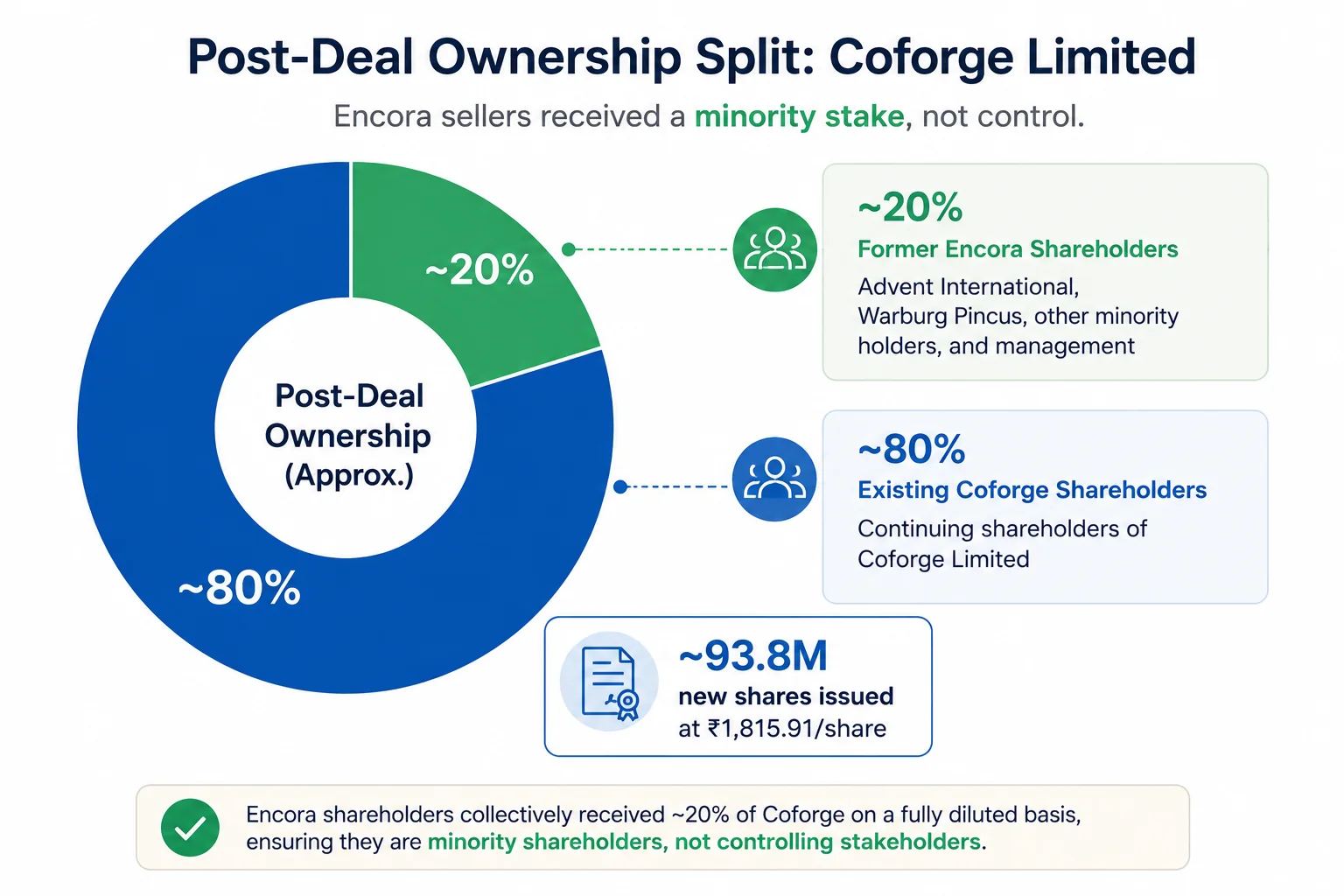
| Structure | All-stock share swap. Coforge issued ~93.8 million equity shares at ₹1,815.91 apiece to Encora's shareholders, who end up owning ~20% of combined Coforge |
| Announced | Definitive agreement signed December 26, 2025. Closed May 1, 2026 after statutory and regulatory clearances |
| Region | Cross-border: Indian public company acquiring a US-headquartered firm with India/Latin America delivery scale |
| Tags | IT services / ER&D consolidation / all-stock acquisition / $2.35B (~₹20,445 cr) / PE sponsor exit / AI capability buy |
The One-Line
Coforge used its own liquid, publicly traded stock to buy AI-engineering scale it could not organically build in time, while letting two private equity sponsors trade a controlling but illiquid position for a tradeable ~20% stake in a profitable listed acquirer.
What Happened
The announcement and the timeline
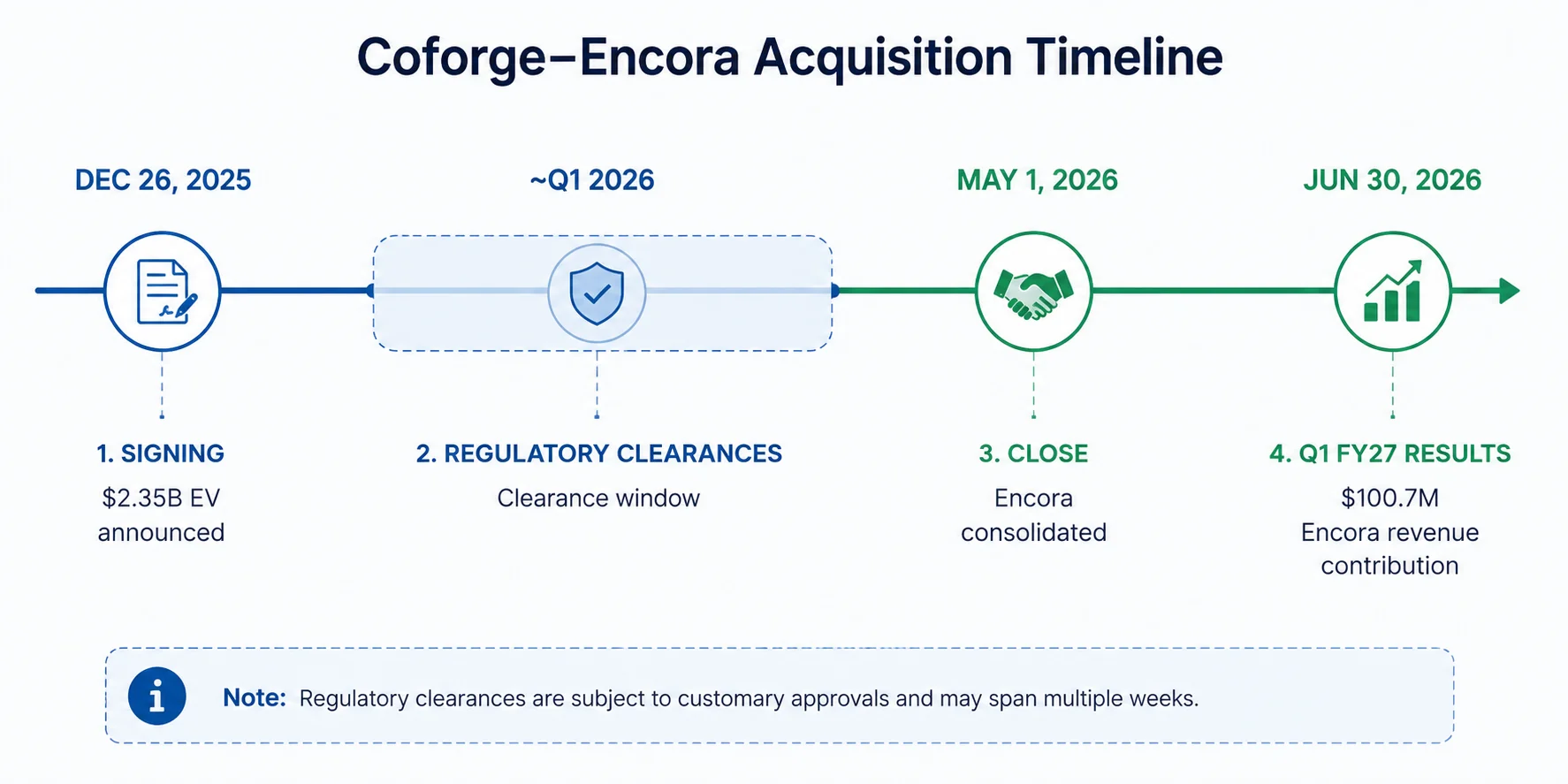
- December 26, 2025: Coforge signs definitive agreements to acquire 100% of Encora for an enterprise value of $2.35B (~₹20,445 crore), entirely in stock. Coforge frames it publicly as reaffirming intent "to be the leading AI-driven engineering firm for the new era."
- December 2025 – April 2026: Deal proceeds through statutory and regulatory clearances across the relevant jurisdictions; Coforge confirms it has received all approvals before closing.
- May 1, 2026: Deal closes. Encora is consolidated into Coforge's financials from this date, later confirmed by Q1 FY27 reporting.
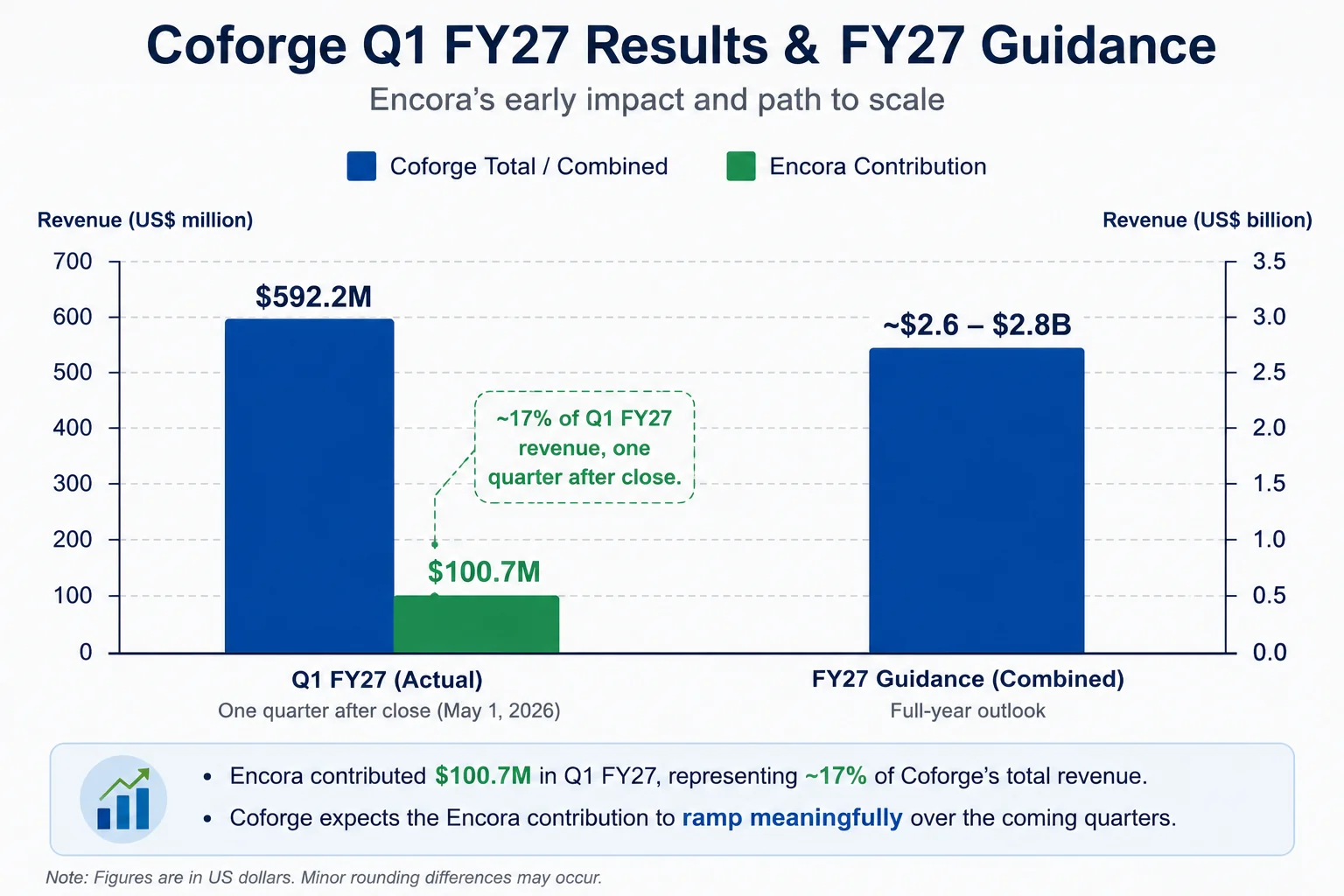
- Q1 FY27 (quarter to June 30, 2026): First full quarter with Encora inside the numbers. Coforge reports $592.2M revenue, up 33.3% year-on-year, of which Encora contributed $100.7M.
Who Encora is, and why it existed to be sold
- Founded in 2000 by Vinit Kadkol, Kinesh Doshi and Venu Raghavan as Indecomm Digital Services, later rebranded Encora.
- Warburg Pincus took majority control in 2019, financing the rebrand and repositioning around digital engineering.
- Advent International bought a majority stake in December 2021 for a reported ~$1.5B, with Warburg Pincus retaining a minority position.
- By the time of the Coforge deal, Encora had grown to
9,000 associates across 47+ delivery centers in the US, Canada, Latin America, Europe, India and Southeast Asia, with FY26E revenue of roughly $600M (₹5,220 crore) and an adjusted EBITDA margin of ~19%.
This is a standard four-to-six-year PE hold-period exit, timed into a strategic buyer able to pay a premium in stock, rather than a secondary PE-to-PE sale or an IPO in a soft market for services businesses.
What Coforge is actually buying
- Direct capability in AI-led product engineering, cloud services and data engineering — the exact categories management says will generate close to $2B (~₹17,400 crore) of combined revenue by FY27.
- A US-geography and vertical gap-fill: Coforge has said the deal strengthens its presence in the North American West and Midwest, and deepens healthcare and hi-tech vertical exposure.
- Immediate revenue materialization: Encora already contributed $100.7M to Coforge's very first post-close quarter, a faster proof point than most acquisitions offer.
The Numbers
Deal terms
| Metric | Value | Period | Status |
|---|---|---|---|
| Deal enterprise value | $2.35B (~₹20,445 crore) | At signing/close | Reported |
| Coforge shares issued to sellers | ~93.8 million @ ₹1,815.91/share | At close | Reported |
| Sellers' resulting stake in Coforge | ~20% | Post-close | Reported |
| Advent's 2021 entry price for majority stake | Dec 2021 | Reported | |
| Implied EV / revenue multiple | ~3.9x | On FY26E revenue | Kautilya calc |
Encora, pre-close
| Metric | Value | Period | Status |
|---|---|---|---|
| Encora FY26E revenue | FY26E (pre-close estimate) | Reported | |
| Encora adjusted EBITDA margin | ~19% | FY26E | Reported |
Coforge, buyer financials
| Metric | Value | Period | Status |
|---|---|---|---|
| Coforge FY26 revenue | ₹164.8B (~$1.89B) | FY26, to Mar 2026 | Reported |
| Coforge FY26 net income | ₹14.9B (~$171M), up 77% YoY | FY26 | Reported |
| Coforge Q1 FY27 revenue | $592.2M (~₹5,151 crore), up 33.3% YoY | Qtr to Jun 30, 2026 | Reported |
| Encora's contribution to Q1 FY27 | $100.7M (~₹876 crore) | Qtr to Jun 30, 2026 | Reported |
| Coforge Q1 FY27 net profit | ₹518.6 crore (~$60M) | Qtr to Jun 30, 2026 | Reported |
| Combined FY27 revenue guidance | ₹244B (~$2.8B), +49% YoY | FY27 guidance | Reported (management) |
| Combined EBIT margin guidance | ~14% | FY27 guidance | Reported (management) |
What we can infer
- The implied multiple, ~3.9x FY26E revenue, is a Kautilya calculation, built from Encora's estimated ~$600M pre-close revenue against the $2.35B headline EV. Treat it as directional: the $600M figure is itself a pre-close estimate from deal materials, not an audited final-year number.
- Encora grew roughly 4x in enterprise value in about 4.5 years under sponsor ownership — Advent's entry implied a business valued in the low billions in 2021; Coforge's price implies $2.35B in 2025. Some of that gap is Encora's own growth, some is the premium a strategic acquirer pays over what a financial sponsor paid for control.
- Encora is already earning its price. $100.7M of first-quarter contribution against a $2.35B EV annualizes to roughly $400M/year at that run-rate alone, before accounting for cross-sell — a faster-than-usual proof point that the asset was not overpaid on a pure cash-generation basis.
Two adjustments before calling the price rich or cheap
- The EV/revenue multiple is not directly comparable to a pure IT-services deal. Encora sells engineering and AI product-development services, a higher-margin, higher-growth category than commodity IT outsourcing, which typically supports a richer multiple than the 2-3x seen in lower-margin BPO or staffing deals.
- The $600M FY26E figure is an estimate made before the deal closed, not an audited actual. If Encora's real FY26 revenue lands materially above or below that number, the 3.9x multiple moves with it, and neither side has disclosed the final audited figure at time of writing.
The Structure
An all-stock acquisition of a profitable, growing asset by a strategic buyer, with the entire consideration paid in newly issued public shares rather than cash or debt.
- Zero cash, entirely in Coforge stock. Coforge issued ~93.8 million new shares directly to Encora's sellers rather than raising or spending cash, preserving its balance sheet while still executing its largest-ever acquisition.
- A clean sponsor handoff, not a messy cap table. Two institutional sponsors (Advent, Warburg Pincus) plus management and other minority holders received shares proportionate to their stakes — a simpler seller group than a founder-heavy or venture-backed cap table.
- Sellers received a ~20% stake in a listed company, meaningfully more liquid than an all-stock swap into another private company. Advent and Warburg Pincus can sell into the public market over time, subject to any lock-up, rather than waiting for Coforge's next private valuation event.
- Full regulatory clearance secured before close. Coforge explicitly confirmed receipt of "all statutory and regulatory clearances" ahead of the May 1 closing, resolving the largest source of deal-break risk before the transaction completed.
- Immediate consolidation. Encora's financials entered Coforge's books from May 1, 2026, with no extended transition period disclosed — a sign the deal was structured for a fast, clean integration rather than a staged handover.
Which risk did each side actually manage, and which did they leave open?
- Coforge's accepted risk. It diluted existing shareholders by roughly 20% to fund the deal, and it now carries integration risk for a ~9,000-person organization spread across 47+ delivery centers, nearly doubling its geographic footprint in one transaction. In exchange, it avoided any cash outlay and can point to $100.7M of Encora revenue landing in its very first post-close quarter.
- The sellers' accepted risk. Advent and Warburg Pincus gave up board control of Encora and now hold a minority position in a company they do not run. Their return depends on Coforge's stock performance and the market's view of the combined entity, not on Encora's standalone results alone.
- What neither side resolved. Whether the ~$2B combined AI/cloud/data revenue target for FY27 is achievable once integration costs and any client overlap or attrition are accounted for — the guidance is management's own, not yet tested by a full fiscal year of combined trading.
Why It Matters
The obvious read is "Indian IT buys AI capability, story of the year." Three sharper ones:
1. Stock is becoming the standard currency for Indian tech M&A, not the exception.
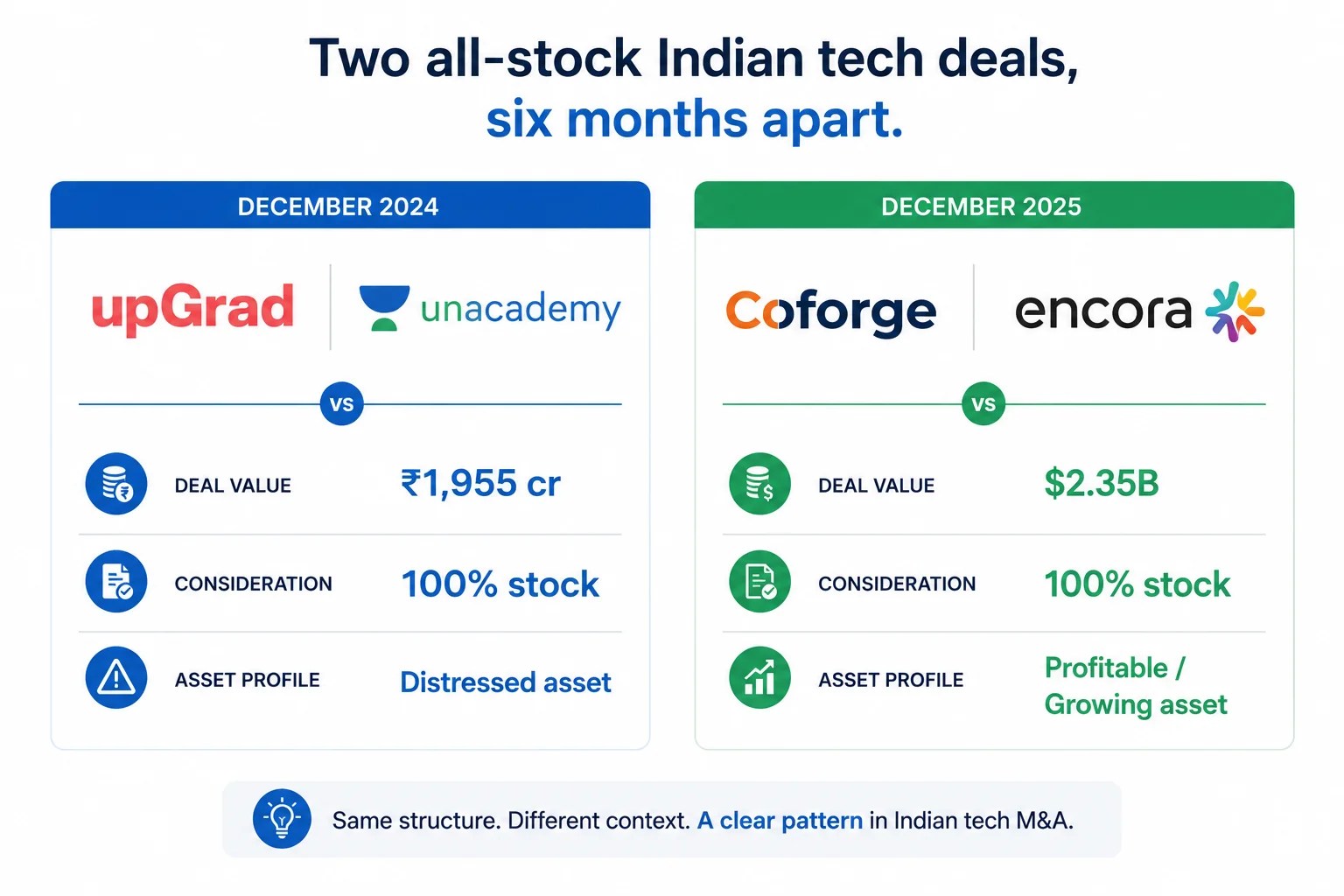
- This is the second major all-stock Indian tech acquisition worth this kind of teardown in 2026, after upGrad's stock-funded purchase of Unacademy.
- Both deals let a buyer with limited spare cash — Coforge issuing new shares rather than drawing on its balance sheet, upGrad doing the same from a smaller profit base — acquire at scale without a lender or a cash reserve.
- Any listed company with credible, liquid stock can now run this playbook, and the two deals together suggest 2026 is the year Indian strategics normalized paying with paper for scale acquisitions.
2. A PE sponsor exit into a strategic buyer's stock is a third path beyond the usual IPO-or-secondary choice.
- Advent held Encora for roughly four years, a standard hold period, but instead of an IPO (a difficult market for services businesses) or a PE-to-PE secondary, it exited into ~20% of a listed strategic acquirer.
- That gives Advent and Warburg Pincus public-market liquidity over time without the execution risk of running an IPO process.
- For any operator or sponsor planning an exit in a soft listing market, a stock-for-stock strategic sale into a liquid public acquirer is a genuine third option, not just a consolation prize versus an IPO.
3. Buying a profitable, growing asset in stock is a fundamentally different bet than buying a distressed one.
- Unlike the Unacademy deal, Encora arrived with a ~19% EBITDA margin and immediate revenue contribution ($100.7M in the first quarter alone) — there was no markdown story and no walk-away leverage to exploit.
- Coforge's price discipline here has to be judged on multiple and integration execution, not on negotiating a distressed seller down.
- The lesson for buyers is the opposite of the Unacademy playbook: when the target is healthy and growing, the buyer's edge comes from balance-sheet discipline (paying in stock, not cash) and fast integration, not from a public walk-away.
The Buyer's Takeaway
Written for the strategic acquirer and PE-sponsor lens, what this teaches anyone structuring a stock-funded scale acquisition:
- Use your own liquid stock as acquisition currency when the target is healthy, not just when it's distressed. Coforge did not need leverage or a markdown to justify paying in shares; a listed acquirer's stock is a legitimate, cash-preserving currency for buying a profitable, growing asset, provided the seller values liquidity in your stock.
- Judge the multiple against the category, not the sector average. A 3.9x revenue multiple looks rich against commodity IT services and reasonable against AI/engineering services with a 19% EBITDA margin. Know which comp set you are actually in before calling a price expensive — see our guide to business valuation in India for how to build a comparable set.
- A fast first-quarter revenue contribution is the best early proof point you will get. Encora's $100.7M in Coforge's first post-close quarter is a real, immediate signal of deal quality. If a newly acquired unit is not visibly contributing within one full quarter, treat that as an early integration warning, not a rounding error.
The limit: this playbook needs an acquirer whose stock is genuinely liquid and credible to institutional sellers. Advent and Warburg Pincus accepted Coforge shares because Coforge is a listed, actively traded company with real public float. A private or thinly traded acquirer cannot offer the same liquidity upgrade, and a sponsor with a cash bidder on the table has little reason to accept illiquid or thinly traded paper instead.
The Kautilya Deal Score
| Axis | Score |
|---|---|
| Price Discipline | ★★★☆☆ (3.5) |
| Structure & Risk Absorption | ★★★★☆ (4.0) |
| Cash-Flow Quality | ★★★★☆ (4.5) |
| Strategic Fit / Value Path | ★★★★☆ (4.5) |
| Replicability | ★★★☆☆ (3.5) |
| Overall | ★★★★☆ (4.0 / 5) |
Verdict: Blueprint. This is a materially stronger deal than most stock-funded teardowns, precisely because the asset itself is strong. Cash-flow quality is the standout axis: a ~19%-EBITDA-margin business that had already contributed over $100M to the buyer's books within one quarter of closing is about as clean a cash-flow picture as an acquisition teardown gets. Strategic fit is equally high, since the AI, cloud and data-engineering categories Coforge targeted are already showing up in guided revenue. Structure and risk absorption favor the buyer: zero cash spent, full regulatory clearance secured before close, immediate consolidation. Price discipline sits in the middle, since the ~3.9x revenue multiple is reasonable for the category but not demonstrably cheap, and it rests on a pre-close revenue estimate rather than an audited actual. Replicability is real but bounded to acquirers with genuinely liquid public stock, which is a smaller set than "any company with a good balance sheet."
Full reasoning per axis is in the Numbers, Structure, and Why It Matters sections above — this table is the scorecard, not the argument.
The Operator's Take
This is the deal I'd point to if someone asked what a well-run, stock-funded scale acquisition looks like in 2026. The thing that convinces me is not the $2.35B headline, it's the $100.7M Encora contributed in Coforge's very first quarter with it inside the numbers. That is a real, fast signal that the asset was priced on genuine cash flow, not a growth story. What I'd still want to see before calling this a clean win is one full fiscal year of the combined FY27 guidance actually landing, because a ~$2B AI/cloud/data revenue target from management is a promise, not a result yet. If Coforge hits that guidance with margins intact, this was one of the best-structured Indian tech acquisitions of the year. If integration costs erode the 14% combined EBIT margin target, the ~20% dilution to existing shareholders will look expensive in hindsight.
— Dev Shah
Sources & Method
Sources, by confidence
- High — Deal announcement date (December 26, 2025), enterprise value of $2.35B, all-stock structure: Coforge Buys Encora at $2.35 Billion EV in All-Stock Deal — Bloomberg.
- High — Share count (~93.8 million shares), share price (₹1,815.91), sellers' resulting ~20% stake: Coforge to buy AI firm Encora for $2.35 billion in all-stock deal — Business Standard.
- High — Coforge FY26 revenue (₹164.8B) and net income growth: Coforge delivers 29.2% YoY Growth for FY26 — Coforge Newsroom and Yahoo Finance coverage.
- High — Coforge Q1 FY27 revenue ($592.2M), Encora's $100.7M contribution, net profit (₹518.6 crore): Coforge Q1 FY2026-27 Results — Kotak Neo and Coforge Q1 FY27 slides: Encora deal drives revenue surge — Investing.com.
- High — Combined FY27 revenue guidance and EBIT margin target, and the ~$2B AI/cloud/data revenue breakdown: Coforge Q1FY27 Earnings Conference Call Transcript — Coforge Investor Relations and Coforge Delivers 49% YoY Growth, PAT Increases 110% YoY — Coforge Newsroom.
- High — Advent International's ~$1.5B majority-stake purchase of Encora in December 2021, with Warburg Pincus retaining a minority position from its 2019 majority buyout: Advent International Acquires Majority Stake in Encora — PR Newswire and Advent International picks up majority stake in Encora for $1.5 billion — Business Standard.
- Medium-high — Encora's FY26E revenue (~$600M) and adjusted EBITDA margin (~19%): reported via deal-coverage outlets citing deal materials, not an independently audited filing.
- Medium — Encora's founding year, employee count (~9,000) and office footprint (47+ locations): Encora company profile — Built In.
Kautilya's own calculations (not disclosed figures): the ~3.9x implied EV/revenue multiple on Encora's FY26E revenue; the annualized ~$400M run-rate implied by Encora's first-quarter contribution. Treat all of these as directional.
Open items we could not verify
- Lock-up terms, if any, on the ~93.8 million shares issued to Encora's sellers. Not disclosed in sources reviewed; material to how quickly Advent and Warburg Pincus can realize liquidity.
- Encora's final audited FY26 revenue, versus the pre-close ~$600M estimate used in deal materials — the true implied multiple depends on this figure.
- Named leadership retention or departures at Encora post-close (CEO, founding team). Not found in current sources.
- Any planned office or headcount consolidation given overlapping India delivery presence between the two companies. Not disclosed in sources reviewed.
- The exact FY26E vs. FY26 basis mismatch: Coforge's own FY26 (ended March 2026) and Encora's FY26E (calendar-year basis, pre-close estimate) are not on the same fiscal calendar; readers comparing the two revenue figures directly should note this.
If you're evaluating your own acquisition, our step-by-step guide to buying a business in India covers the process from criteria to closing at the SME scale most buyers actually operate at.
Disclaimer: This teardown is based on publicly reported deal terms and financial filings as summarized by the sources above. It is analysis, not investment or legal advice — verify current figures independently before relying on them for a transaction of your own.
Frequently Asked Questions
How much is Coforge paying for Encora?
$2.35 billion (roughly ₹20,445 crore) in enterprise value, paid entirely in Coforge stock. Coforge issued about 93.8 million new equity shares at ₹1,815.91 apiece to Encora's shareholders, who end up owning roughly 20% of the combined company. No cash changed hands.
Who owned Encora before the sale?
Advent International held majority control since a ~$1.5 billion buyout in December 2021, with Warburg Pincus — which had taken majority control in 2019 and financed Encora's rebrand — retaining a minority stake. Both sponsors, plus management and other minority holders, converted their stakes into roughly a combined 20% of publicly listed Coforge.
Is the Coforge-Encora deal expensive or cheap?
The implied multiple is roughly 3.9x Encora's estimated FY26E revenue of ~$600M — a Kautilya calculation, not a disclosed figure. That looks rich next to commodity IT services (typically 2-3x) but reasonable for AI-led product engineering with a ~19% EBITDA margin. The real test is whether the ~$2B combined AI/cloud/data revenue guidance for FY27 actually lands.
Why did Coforge pay in stock instead of cash?
Paying in shares let Coforge complete its largest-ever acquisition without touching its balance sheet or taking on debt. It diluted existing shareholders by roughly 20%, but avoided any cash outlay — and Encora was already profitable and growing, so there was no distressed-asset markdown to negotiate for.
How fast is Encora contributing to Coforge's revenue?
Immediately. In Coforge's very first full quarter with Encora consolidated (Q1 FY27, quarter to June 30, 2026), Encora contributed $100.7M — about 17% of Coforge's total $592.2M quarterly revenue, which grew 33.3% year-on-year.
Stay Updated
Get the latest insights on business acquisition delivered to your inbox.
Subscribe to Newsletter