UpGrad's ₹1,955 Crore Acquisition of Unacademy, Explained
Yes — UpGrad acquired Unacademy for ₹1,955 crore (~$204M) in an all-stock deal, 30% below the valuation it walked away from six months earlier. Here's why, and what changes for both companies.
Dev Shah
1 August 2026
UpGrad is acquiring Unacademy (Sorting Hat Technologies) for ₹1,955 crore (~$204M) in an all-stock deal — a price roughly 30% below the ~$290M valuation UpGrad walked away from just six months earlier. The transaction closes one of Indian EdTech's most closely watched consolidation stories, and it's a rare, well-documented case study in how a public walk-away can function as a genuine pricing lever rather than a negotiating bluff.
The Snapshot
| Buyer | UpGrad |
| Target | Unacademy (Sorting Hat Technologies) |
| Sector | EdTech / online education |
| Size / price | ₹1,955 crore (~$204M), all-stock |
| Structure | 100% share-swap; Unacademy shareholders receive UpGrad equity, ~10.7% dilution to existing UpGrad holders |
| Timeline | Talks began Nov 2025, UpGrad walked away Jan 2026, term sheet signed Mar 2026, CCI cleared Jul 2026 |
| Implied multiple | ~2.37x FY25 trailing revenue |
| Tags | EdTech / all-stock deal / distressed-asset pricing / walk-away leverage / consolidation |
The Core Transaction
The all-stock structure means Unacademy shareholders receive UpGrad equity rather than cash, and UpGrad avoids drawing down its own balance sheet to fund the deal. At ₹1,955 crore (~$204M), the final price sits roughly $86M below the ~$290M figure reportedly on the table in January 2026, when UpGrad first walked away from negotiations citing valuation disagreements.
Initial term-sheet reporting in March 2026 cited a ₹2,055 crore figure, later revised down to the final ₹1,955 crore confirmed at signing — the ₹100 crore difference reflects final negotiation before close.
Why the Walk-Away Mattered
The six-month gap between the walk-away and the eventual deal is the most instructive part of this transaction. By publicly exiting negotiations and citing valuation disagreement, UpGrad signaled — credibly — that it was prepared to let the deal die rather than overpay. That signal appears to have reset the negotiating baseline: the ~$86M gap between the walked-away valuation and the final price represents nearly a third of the eventual deal value.
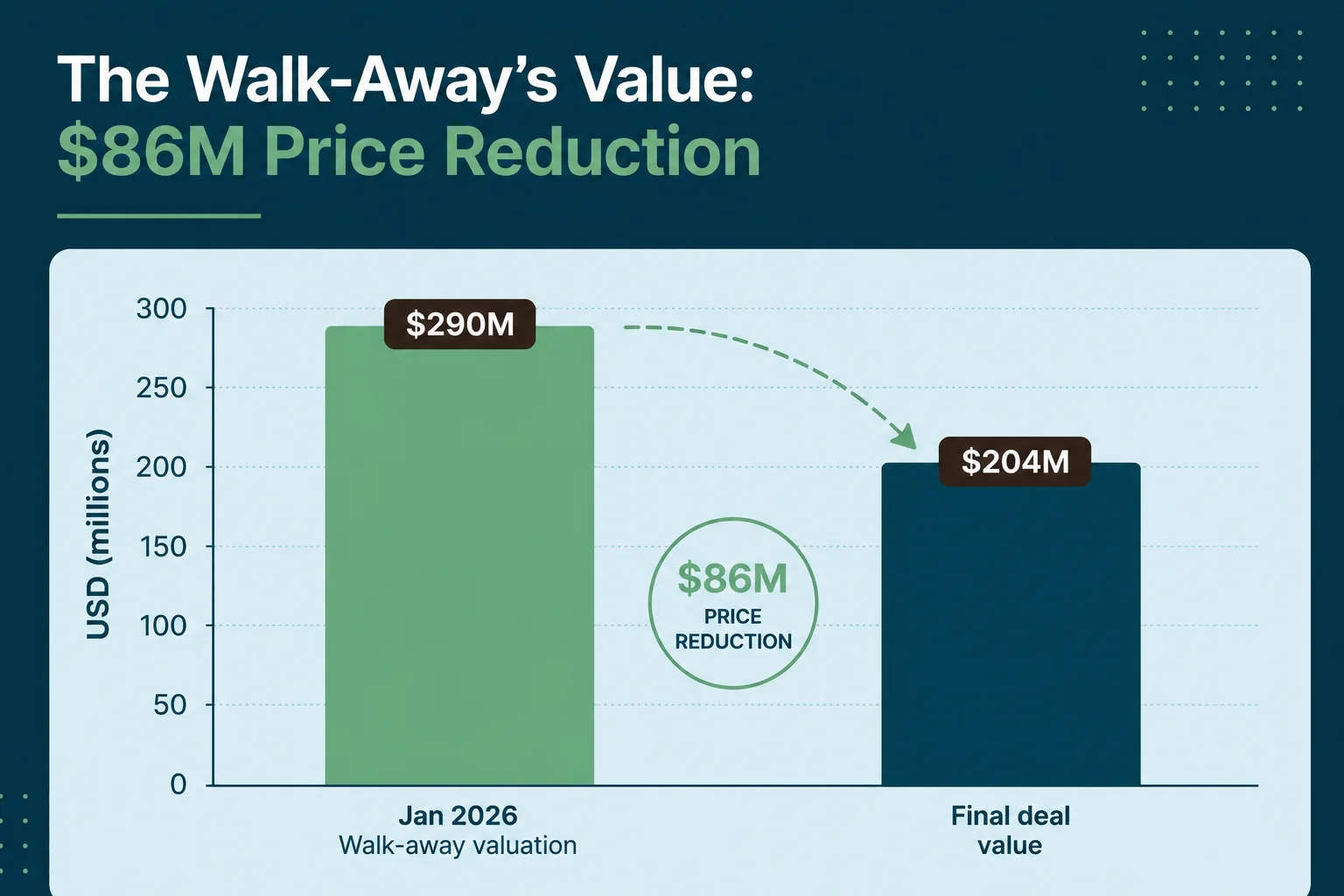
This is a pattern worth watching beyond this specific deal: in markets where a target's financial position is deteriorating, a credible public walk-away can function as a legitimate price-discovery mechanism, provided the buyer is genuinely willing to let time work against the seller.
Asset Condition: A Shrinking, Loss-Making Business
Unacademy's consolidated revenue declined 16% year-over-year to ₹826 crore ($86M) in FY25, alongside a net loss of ₹436 crore ($45M) — a 31% improvement on the prior year's losses. At the agreed price, the deal values the company at roughly 2.37x trailing revenue for a business that is both shrinking and unprofitable.
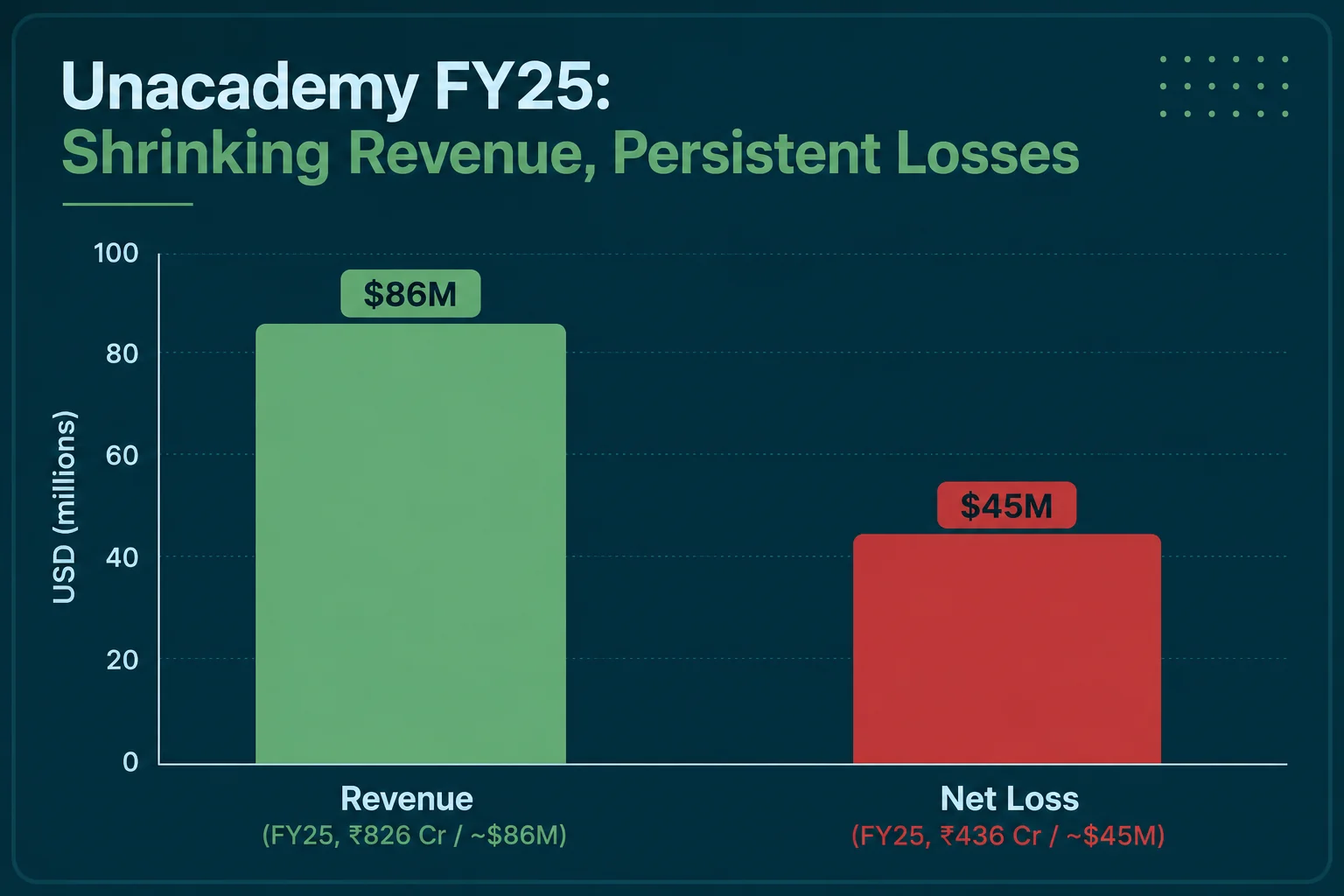
That multiple is meaningfully more conservative than what growth-stage EdTech assets commanded during the 2020-2021 funding boom, underscoring how far sector valuations have reset.
Payment Structure and Its Trade-offs
UpGrad structured the transaction with zero cash consideration — the entire deal is funded in UpGrad equity. This diluted existing UpGrad shareholders by an estimated 10.7%, but it preserved UpGrad's cash position, which matters given the company only recently achieved profitability itself. In effect, UpGrad traded ownership dilution for balance-sheet safety, a reasonable trade-off for a buyer that cannot yet absorb a large cash outlay without risk.
What This Means for Unacademy's Investors
For Unacademy's cap table, this deal is not the exit most investors were underwriting. Shareholders are converting already marked-down positions into illiquid UpGrad stock, with minimal governance influence going forward — collectively, all investors retain just one board seat. Rather than achieving liquidity, Unacademy's investors have effectively transferred their remaining risk to a new, functionally private-equity-style holder (UpGrad) without securing the control or governance rights that would typically accompany that kind of risk transfer.
Deal Timeline
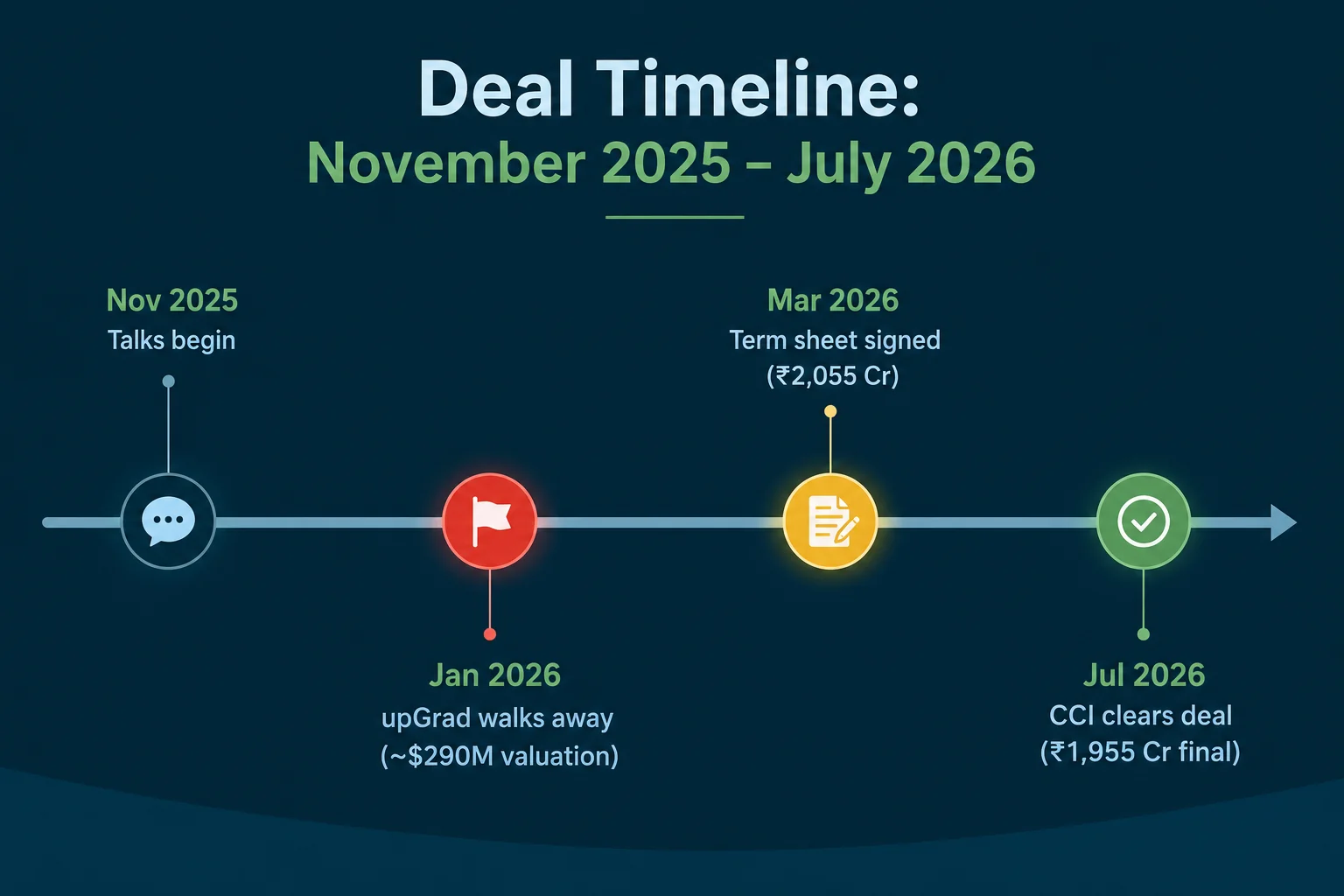
Understanding this acquisition requires tracing how it evolved over roughly six months. The relationship between the two companies moved from an apparent breakdown to a completed transaction in a relatively short window for a deal of this size and complexity.
- November 2025 — Talks begin between UpGrad and Unacademy.
- January 2026 — Talks stall; UpGrad publicly walks away, citing valuation disagreements and concerns over Unacademy's shrinking core business and offline-coaching competition. Reported terms at the time value Unacademy at approximately $290M, down over 90% from its 2021 peak of $3.4B.
- March 2026 — UpGrad and Unacademy sign a term sheet for a 100% share-swap deal, initially reported at ₹2,055 crore.
- July 2026 — The Competition Commission of India (CCI) clears the deal; most investors sign off, with completion at the revised ₹1,955 crore value.
How This Compares to Other EdTech Consolidation
This deal fits a broader pattern across Indian EdTech since the sector's 2021 funding peak: well-capitalized platforms with sustainable unit economics acquiring cash-burning peers at valuations far below their last private funding rounds. The 2.37x trailing-revenue multiple here is consistent with — if not more conservative than — comparable distressed EdTech transactions in the same period, where multiples compressed sharply from the 15-20x revenue multiples common during the pandemic-era boom.
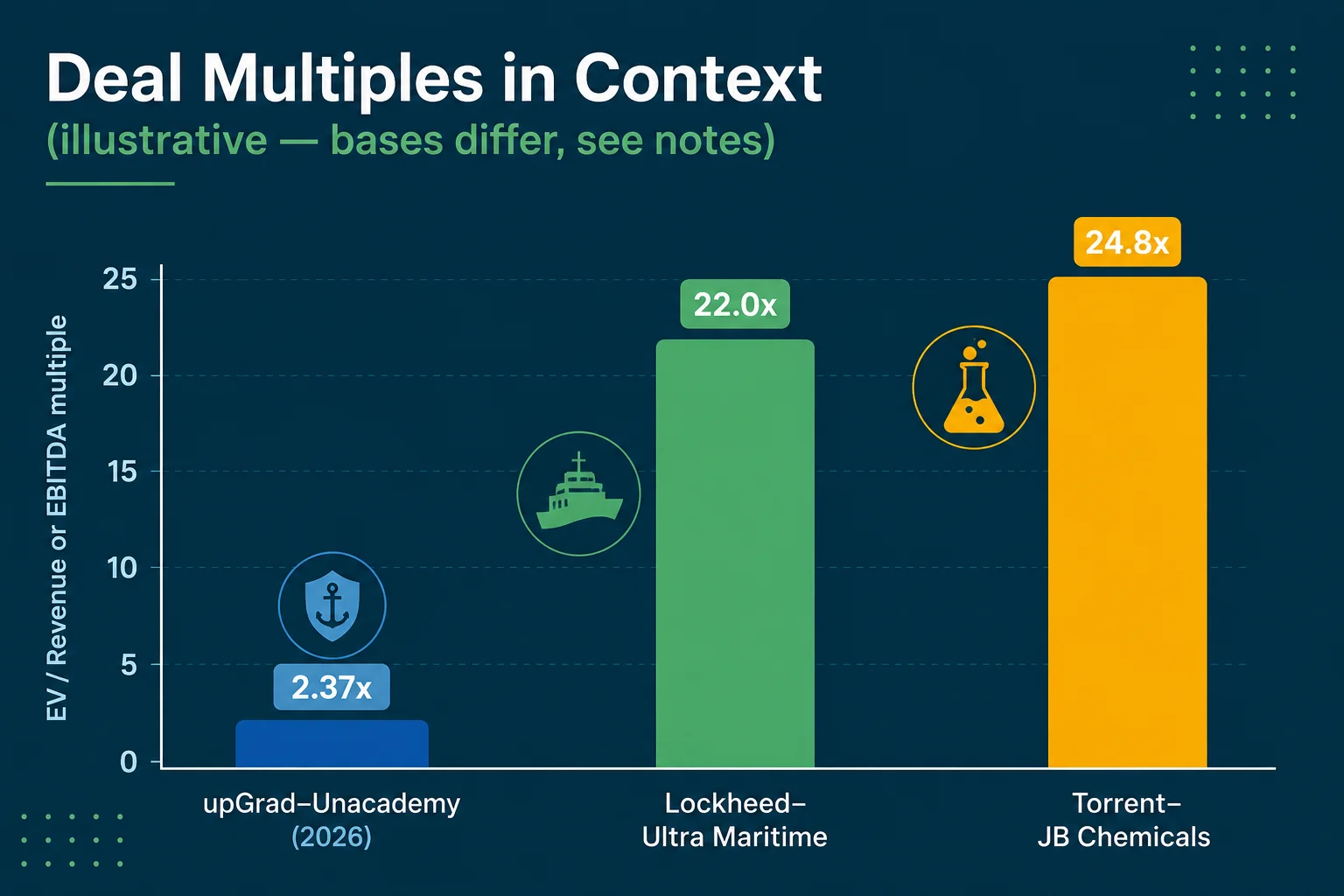
Note: the UpGrad–Unacademy figure shown is EV/Revenue (2.37x); the comparison deals are EV/EBITDA. The bases aren't directly equivalent and are shown for context, not a like-for-like comparison.
What differentiates this transaction from typical distressed M&A is the documented walk-away. Most down-round acquisitions happen quietly, with final terms disclosed only after signing. UpGrad's public exit from talks created a visible before-and-after data point — the ~$86M gap — that makes this deal unusually easy to study as a negotiating case, rather than just as a valuation outcome.
What Changes for Unacademy's Product and Users
For learners and educators on the Unacademy platform, the acquisition raises the usual post-M&A questions: product integration timelines, brand continuity, and whether existing subscriptions, educator partnerships, and content libraries carry over unchanged. UpGrad has signaled, as most acquirers do at this stage, an intent to preserve the Unacademy brand and educator ecosystem in the near term, though the specifics of platform integration, potential layoffs, and product roadmap consolidation typically emerge only in the months following close.
The more consequential product question is competitive positioning: UpGrad's core strength has historically been higher-education and professional upskilling, while Unacademy is rooted in test-prep and competitive-exam coaching. Whether the combined entity pursues genuine cross-sell between these audiences, or simply runs Unacademy as a separately branded, standalone unit, will determine whether this acquisition creates real product synergy or is primarily a financial consolidation.
Analyst Outlook and Risk Factors
Three factors will determine whether this acquisition is judged a success twelve months out:
- Integration execution — whether UpGrad can stabilize Unacademy's revenue decline without disrupting the educator and learner base it just acquired.
- Dilution absorption — whether UpGrad's stock can absorb an estimated 10.7% dilution without depressing shareholder returns, particularly given the company's own recent path to profitability.
- Governance clarity — with only one board seat across all of Unacademy's prior investors, how much influence those investors retain over strategic decisions post-close is unclear, and could shape how smoothly integration proceeds.
The core risk is straightforward: UpGrad has acquired a shrinking, loss-making asset at a discount, but a discount does not guarantee a good outcome if the underlying business continues to decline post-acquisition. The walk-away strategy secured a better price; it did not, on its own, fix Unacademy's fundamentals.
The Replicability Factor: A Transferable Playbook
The most transferable lesson from this teardown isn't the price — it's the mechanism. Combining a credible, public walk-away with an all-stock deal structure gives acquirers two forms of leverage at once: a real cost to the seller for holding out (continued cash burn, morale and talent risk, no liquidity event), and a way to make the eventual price more palatable by not requiring cash the buyer may not want to spend. For other consolidators eyeing distressed but strategically valuable EdTech assets, this deal is a template worth studying.
Bottom Line
This deal is less a story about Unacademy's turnaround prospects than about negotiating discipline. UpGrad demonstrated that patience and a willingness to walk can be worth tens of millions of dollars in a distressed-asset acquisition — a lesson that will likely echo through EdTech M&A conversations well beyond this single transaction.
For founders, investors, and dealmakers watching the broader EdTech consolidation wave, the practical takeaway is less about this specific price tag and more about sequencing: distressed sellers rarely regain leverage by waiting, and buyers who can credibly walk away — and are genuinely prepared to follow through — are the ones who end up setting the final terms. Whether UpGrad can convert this pricing win into operational integration success is the open question that will define how this acquisition is remembered a year from now.
If you're earlier in your own acquisition process rather than tracking a public deal, our step-by-step guide to buying a business in India covers the process at the SME scale most buyers actually operate at.
Sources
- UpGrad to Complete Unacademy Acquisition in Rs 1,955 Crore Deal — SiliconIndia
- UpGrad to acquire Unacademy in Rs1,955cr all-stock deal, CCI cleared — NewsBytes
- Unacademy to be acquired by UpGrad in share-swap deal — TechCrunch
- From $3.4 billion to $290 million: UpGrad walks away from Unacademy deal — Upstox
- Explainer: Why the UpGrad–Unacademy deal collapsed — Forbes India
- Exclusive: Unacademy narrows EBITDA losses by 38% in FY25 — Entrackr
Frequently Asked Questions
How much is UpGrad paying for Unacademy?
₹1,955 crore (roughly $204 million) in an all-stock deal, confirmed at signing after the Competition Commission of India (CCI) cleared the transaction in July 2026. Unacademy shareholders receive UpGrad equity rather than cash.
Why did the price drop from $290 million to $204 million?
UpGrad first walked away from talks in January 2026, when reported terms valued Unacademy at roughly $290 million, citing valuation disagreements and concerns about the business's shrinking core and offline-coaching competition. That credible public exit reset the negotiating baseline: by the time a term sheet was signed two months later and the deal closed in July 2026, the price had fallen to ₹1,955 crore (~$204M) — an ~$86M reduction, worth nearly a third of the eventual deal value.
Is this a cash deal or a stock deal?
All-stock. UpGrad is issuing its own equity to Unacademy shareholders rather than paying cash, which dilutes existing UpGrad shareholders by an estimated 10.7% but preserves UpGrad's cash position — a meaningful consideration given the company only recently turned profitable itself.
What multiple is UpGrad paying for Unacademy?
Roughly 2.37x Unacademy's FY25 trailing revenue of ₹826 crore (~$86M). Unacademy is both shrinking (revenue down 16% year-over-year) and loss-making (a ₹436 crore / ~$45M net loss, though 31% narrower than the prior year), so this is a conservative, distressed-asset multiple rather than a growth valuation.
What happens to Unacademy's existing investors?
They convert already marked-down positions into illiquid UpGrad stock rather than achieving a cash exit, and collectively retain just one board seat across all investors — minimal governance influence in the combined company going forward.
Stay Updated
Get the latest insights on business acquisition delivered to your inbox.
Subscribe to Newsletter